
5G FWA Network Architecture for Regional Operators and ISPs
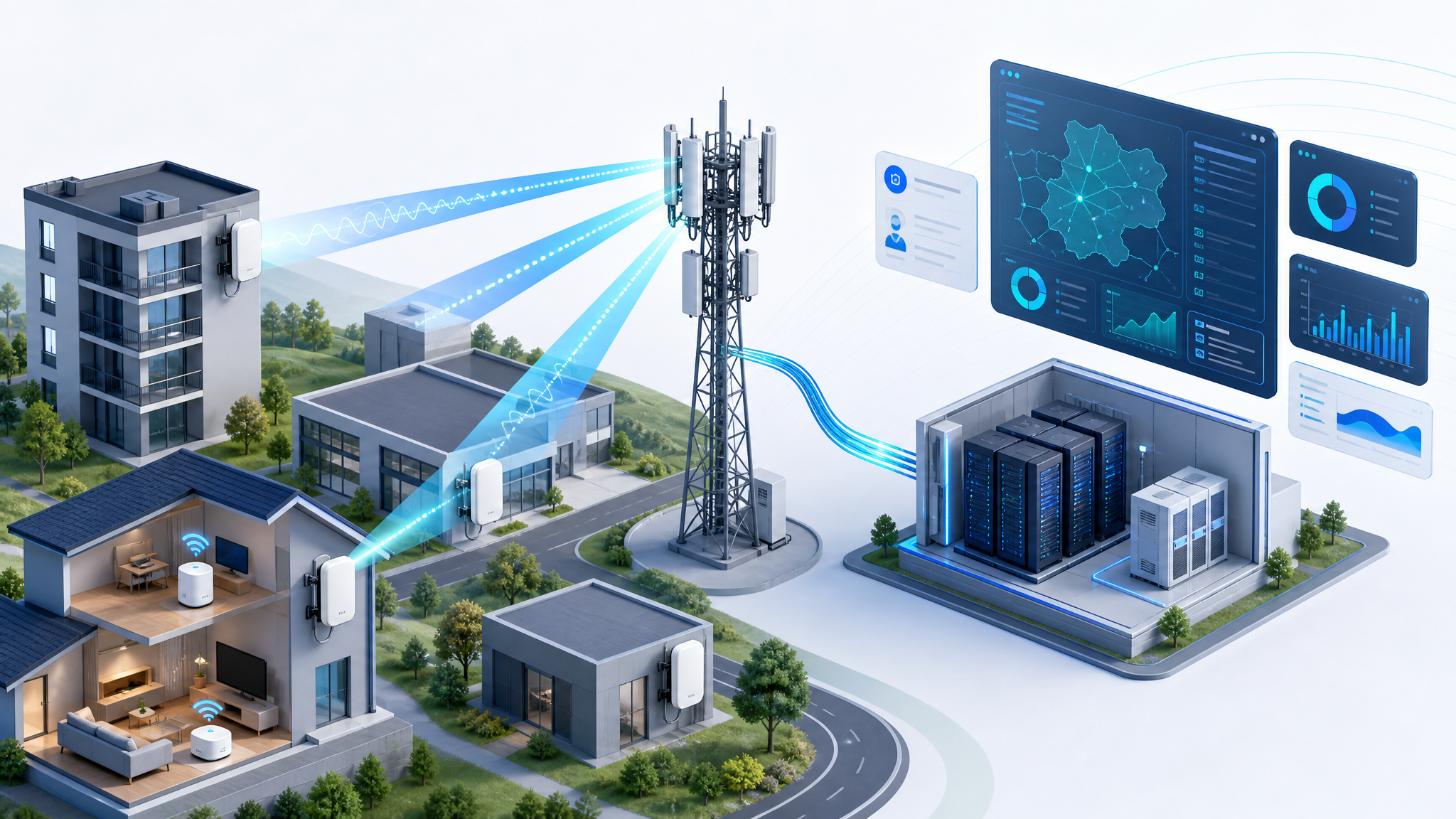
For regional operators, ISPs, WISPs, micro-operators, and FWA project integrators, Fixed Wireless Access is often considered when fiber-to-every-premise is slow, expensive, or operationally difficult. The engineering question is not only which CPE to deploy. A workable service depends on the complete 5G FWA network architecture: customer equipment, radio access, transport, mobile core, operations systems, and field maintenance processes.
A small pilot may start with a limited service area, but the design should not block future expansion into more cells, additional service tiers, hybrid LTE/5G coverage, or optional voice services. The following overview explains the main layers of fixed wireless access architecture from an operator planning perspective.
1. CPE and ODU: Customer-Side Access
The CPE is the customer-side endpoint of the FWA service. Depending on radio conditions and installation requirements, operators may use indoor 5G CPE, outdoor CPE/ODU, or an outdoor unit connected to an indoor router. Indoor CPE is easier to deploy where signal levels are suitable. Outdoor CPE is often selected when antenna placement, link stability, or site alignment requires more control.
Important factors include supported bands, antenna design, SIM or eSIM handling, bridge mode, routing mode, Wi-Fi capability, PoE options, remote diagnostics, and firmware management. Business customers may also need static IP support, VPN compatibility, or LAN integration. Vankom’s 5G CPE & FWA Devices can be positioned in this access layer when operators require device options for different deployment environments.
2. RAN and Base Station Layer
The radio access network determines how effectively the operator can serve a target area. For 5G FWA for operators, the RAN may include macro sites, small cells, localized sectors, or mixed LTE/5G coverage. Use cases can range from towns and suburban communities to villages, industrial parks, campuses, or temporary broadband zones.
Planning should consider spectrum, cell placement, antenna height, terrain, clutter, customer density, interference, uplink demand, and backhaul capacity. FWA cannot be planned only around headline downlink numbers; household and business users increasingly depend on video meetings, cloud tools, surveillance uploads, and remote work applications. Vankom’s vkScell and vkHcell can be evaluated for selected small-cell or localized radio scenarios, subject to spectrum, coverage, and integration requirements.
3. EPC or 5GC: The Service Core
The mobile core handles authentication, session management, policy control, IP address allocation, mobility where applicable, and user-plane forwarding. LTE-based FWA normally uses EPC. 5G Standalone deployments use 5GC. Some operators may run a phased LTE/5G architecture while coverage, devices, and business plans mature.
For LTE/5G core network for FWA, key design choices include centralized versus distributed user plane, redundancy, IP addressing, SIM provisioning, QoS policy, charging records, regulatory interfaces where applicable, and integration with OSS/BSS. A regional ISP may begin with a compact core and later expand capacity or place user-plane functions closer to high-traffic areas. Vankom’s vkEPC and vk5GC can support operators that need an integrated core option, with the final design depending on scale, service model, and migration path.
4. Optional IMS for Voice Services
Many FWA networks are data-first, especially for home broadband or business internet access. IMS is not mandatory for every deployment. It becomes relevant when the operator wants voice services, SIP interconnection, fixed-line replacement packages, or voice continuity with an existing service portfolio.
IMS adds requirements for subscriber voice profiles, numbering, interconnection, SIP routing, QoS handling, emergency calling obligations where applicable, and operational monitoring. Vankom’s vkIMS can be considered when IMS capabilities match the operator’s service roadmap.
5. BSS/OSS and Subscriber Lifecycle
A practical regional ISP 5G deployment must connect the network to business and operations workflows. BSS supports customer plans, subscriptions, activation, billing inputs, and product logic. OSS supports provisioning, fault management, performance monitoring, inventory, configuration, and field operations.
Without this layer, a technically working radio network can become difficult to operate at scale. Teams need workflows for SIM assignment, CPE binding, service tier provisioning, suspension and reactivation, trouble ticket correlation, alarm handling, firmware updates, and usage reporting. Vankom’s vkBOSS can be positioned in this operational layer where integrated business and operations support is required.
6. Operations, Backhaul, and Edge Design
FWA operations require visibility across CPE, RAN, transport, and core domains. Engineering teams should monitor signal quality, cell loading, session failures, packet loss, latency, interface status, resource utilization, and subscriber experience indicators. Remote CPE management is especially important because customer-side issues can quickly turn into field visits.
Backhaul is often the hidden constraint. Fiber, microwave, millimeter-wave transport, leased lines, or hybrid transport may be used depending on geography and economics. The design should account for busy-hour traffic, uplink demand, redundancy, synchronization, latency targets, and future cell growth.
Edge placement also matters. A centralized core can be easier to manage during early deployment, while distributed user-plane functions may reduce transport load or improve latency for selected regions. For rural or isolated areas, local breakout can be considered when upstream capacity is limited, but distributed architecture also increases operational complexity.
7. A Practical Reference Architecture
A typical FWA architecture can be summarized as follows: customer CPE or ODU connects over LTE or 5G radio to the base station; the base station connects through IP transport to EPC or 5GC; the core manages authentication, sessions, policy, and user-plane traffic; optional IMS supports voice services; OSS/BSS platforms manage subscribers, provisioning, monitoring, and lifecycle operations.
For regional operators and ISPs, the best architecture is usually modular. Start with the services required now, while preserving interfaces and capacity planning for future expansion. Vankom’s 5G CPE & FWA Devices, vkScell/vkHcell, vkEPC, vk5GC, vkIMS, and vkBOSS can be combined selectively according to the actual deployment scope. The goal is not to force every component into every project, but to build an architecture that matches coverage, capacity, operations, and business requirements.
Conclusion
FWA is not only a last-mile radio link. It is a service architecture that connects access devices, RAN, core network, OSS/BSS, operations, backhaul, and field workflows. For regional broadband providers, a well-planned 5G FWA network architecture creates a more manageable path from pilot deployment to wider commercial operation. The strongest designs are realistic, modular, and engineered for both network performance and operational sustainability.
FAQ
1. What are the main components of a 5G FWA network architecture?
The main components include CPE or ODU, LTE/5G RAN or base stations, transport and backhaul, EPC or 5GC, optional IMS, OSS/BSS platforms, and monitoring tools.
2. Should regional operators choose EPC or 5GC for FWA?
It depends on the radio technology, service roadmap, subscriber scale, and migration plan. LTE FWA normally uses EPC, while 5G Standalone deployments use 5GC.
3. Is IMS required for Fixed Wireless Access?
No. Many FWA networks are data-only. IMS becomes relevant when the operator plans to offer voice services, SIP interconnection, or fixed-line replacement packages.
4. What should ISPs consider before launching regional 5G FWA?
Important considerations include spectrum, coverage planning, customer density, CPE installation model, backhaul capacity, core network design, OSS/BSS integration, monitoring, field maintenance, and scalability.
Related Vankom Content
What Specs Matter When Choosing 5G CPE for FWA Operators? — a practical checklist covering modem platforms, Wi-Fi 7, Ethernet ports, TR-069, FOTA, band locking, and deployment controls.