
Indoor vs Outdoor 5G CPE: How Operators Should Choose
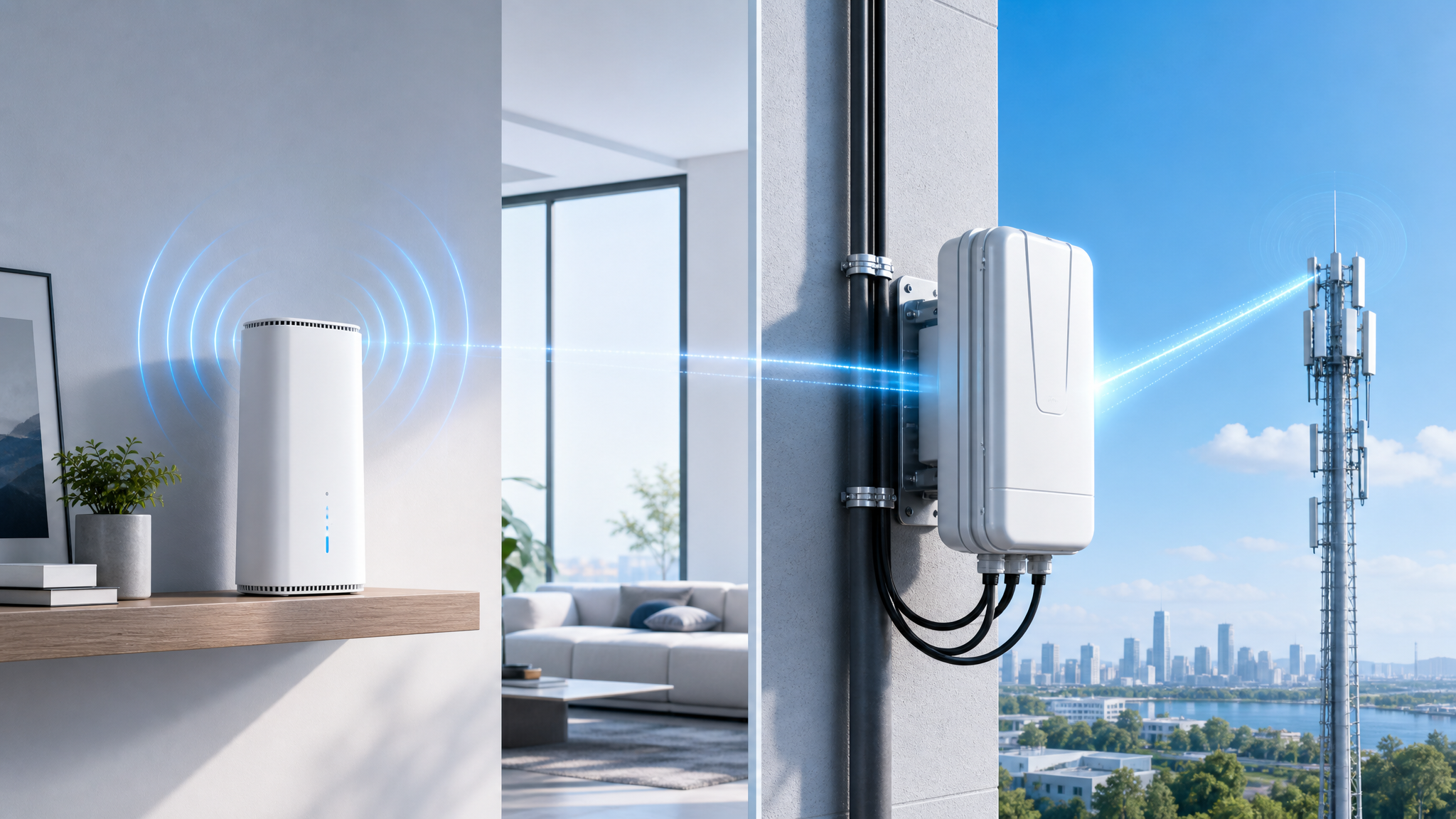
Fixed wireless access is increasingly used by operators, ISPs, WISPs, and regional broadband projects to extend broadband service where fiber deployment is slow, costly, or incomplete. In a 5G FWA network, the customer premises equipment is not just an end-user device. It is the radio access endpoint, service gateway, and often the operational boundary between the operator network and the subscriber environment.
One of the most important deployment decisions is whether to use indoor 5G CPE, outdoor 5G CPE, or a mixed model. The right answer depends on radio conditions, installation constraints, service expectations, available spectrum, and the operator’s support model. A good CPE strategy improves service consistency and reduces avoidable field work. A poor choice can create weak uplink performance, unstable cell-edge experience, or unnecessary installation complexity.
Understanding Indoor and Outdoor CPE Architectures
Indoor 5G CPE is installed inside the subscriber’s home, office, shop, or temporary site. It typically integrates a 5G modem, Wi-Fi, Ethernet LAN, routing functions, and management features in a single desktop or wall-mounted unit. It is usually selected where signal quality is sufficient indoors and where fast, low-friction activation is important.
Outdoor 5G CPE, often called an outdoor CPE ODU, is installed outside the building on a wall, pole, rooftop, balcony, or other elevated position. The ODU contains the 5G radio and antenna system, while indoor connectivity may be provided through Ethernet, PoE power, and a separate indoor router or gateway. Outdoor CPE is normally considered when the best radio location is outside the premise or when antenna orientation toward the serving site needs more control.
Radio Environment Comes First
The radio environment should be the first decision point. Indoor CPE can work well when the serving cell provides sufficient RSRP, SINR, and uplink margin at the indoor placement location. This is more likely in areas with favorable site density, suitable spectrum, lower building attenuation, or near-window placement with acceptable signal quality.
Outdoor CPE becomes more attractive when indoor signal is limited by concrete walls, coated glass, metal roofing, basement placement, vegetation, terrain, or distance from the serving site. Moving the radio unit outside can improve received signal quality and, just as importantly, uplink reliability. For FWA, the uplink often has a major impact on video calls, business applications, cloud backup, and interactive services.
Operators should avoid choosing only by theoretical coverage maps. Drive tests, site surveys, early subscriber data, and installation records provide better guidance for classifying addresses as indoor-first, outdoor-recommended, or survey-required.
Installation Model and Field Operations
Indoor CPE supports a simpler logistics model. It can be shipped to subscribers, installed by retail staff, or deployed by a technician with limited outdoor work. This makes it suitable for dense urban and suburban areas where the network has strong indoor reach and the business model depends on efficient activation.
Outdoor CPE requires more planning. Mounting position, cable routing, grounding practice, weather exposure, PoE power, and antenna alignment all matter. The process may involve trained field teams, installation appointments, and local safety rules. However, this extra work can be justified when it produces more stable radio conditions and fewer repeat support visits in challenging locations.
For many operators, the correct approach is an installation policy rather than a single product choice: indoor CPE for addresses that meet signal and service criteria, and outdoor CPE for cell-edge users, rural premises, enterprise branches, temporary project sites, or buildings with high penetration loss.
Service Tier and Subscriber Segment
CPE type should also match the service tier. Residential best-effort broadband may use indoor 5G CPE where radio conditions are strong. Small business, public sector, rural broadband, and premium service plans may benefit from outdoor CPE when consistency is more important than the simplest installation path.
For WISPs and regional broadband integrators, outdoor CPE is often useful in villages, farms, industrial parks, remote offices, construction zones, and transport corridors, where outdoor mounting may be practical but indoor signal conditions are less predictable.
Wi-Fi, LAN, and Gateway Placement
Indoor CPE combines 5G access and indoor networking in one device, which is convenient but creates a placement tradeoff. The best 5G location may be near a window, while the best Wi-Fi location may be central inside the building. If those locations differ, user experience can suffer even when the cellular link is acceptable.
Outdoor CPE separates the radio position from the indoor network position. The ODU can be mounted where the 5G signal is best, while the indoor router or gateway can be placed where Wi-Fi and Ethernet distribution make sense. This architecture is helpful for larger homes, small offices, multi-room layouts, and sites requiring multiple LAN devices or managed router functions.
Management and Lifecycle Considerations
Operators should select CPE with lifecycle management in mind. Support teams need visibility into radio metrics, device status, firmware versions, LAN status, and fault events. Outdoor CPE adds environmental considerations such as enclosure design, operating temperature range, mounting stability, cable quality, and surge protection strategy. Indoor CPE adds usability considerations such as indicators, placement guidance, Wi-Fi configuration, and local reset behavior.
A Practical Selection Framework
- Start with radio data: classify target areas by measured signal quality, uplink margin, and likely indoor penetration loss.
- Match device type to installation model: use indoor CPE where simple activation is realistic; use outdoor CPE ODU where external placement is needed for service stability.
- Segment by service plan: reserve higher-control installations for business, rural, premium, or mission-relevant broadband plans.
- Separate radio and Wi-Fi when needed: choose outdoor ODU plus indoor router or gateway variants when the best 5G location and best Wi-Fi location are not the same.
- Plan for remote operations: ensure the selected 5G FWA CPE supports the monitoring and configuration model required by the operator’s support process.
Where Vankom CPE Portfolio Fits
Vankom’s CPE portfolio can support operator-specific configurations and regional variants across indoor and outdoor deployment scenarios. Depending on project requirements, operators may evaluate indoor CPE, outdoor CPE/ODU, and router or gateway variants as part of a broader fixed wireless access design. The appropriate configuration should be selected according to target spectrum, network architecture, installation policy, environmental requirements, and subscriber service model.
In some projects, the CPE decision is also connected to the wider network architecture, including core network functions, small cell deployment, private network requirements, or regional broadband rollout plans.
Conclusion
Indoor 5G CPE is best suited to locations where indoor signal quality is reliable, installation simplicity is important, and the subscriber environment does not require an external radio position. Outdoor 5G CPE is better suited to locations where building loss, distance, terrain, or service consistency requirements make external mounting worthwhile.
For operators, ISPs, WISPs, and regional broadband integrators, the strongest strategy is often a mixed portfolio: indoor CPE for efficient activation in strong-signal areas, outdoor CPE ODU for more demanding radio environments, and router/gateway variants for different subscriber and service scenarios.
Suggested related pages: Learn more about Vankom 5G CPE & FWA Devices, explore Fixed Wireless Access for Operators and ISPs, and review supporting network solutions including vkEPC, vk5GC, vkScell, and vkHcell.
FAQ
What is the main difference between indoor and outdoor 5G CPE?
Indoor 5G CPE is installed inside the subscriber premise and often combines 5G access, routing, Wi-Fi, and LAN functions in one unit. Outdoor 5G CPE, or outdoor CPE ODU, is installed outside the building to improve radio placement and is commonly connected to an indoor router or gateway through Ethernet and PoE.
When should operators choose outdoor CPE ODU for 5G FWA?
Operators should consider outdoor CPE ODU when indoor signal quality is limited by building loss, distance, terrain, vegetation, or poor uplink margin. It is also useful for rural broadband, business sites, regional projects, and service tiers that require a more controlled radio installation.
Is indoor 5G CPE suitable for fixed wireless access deployments?
Yes. Indoor 5G CPE can be suitable for fixed wireless access when the serving network provides adequate indoor signal quality and the installation model prioritizes fast activation and simple subscriber logistics. Operators should validate this with field data rather than relying only on coverage maps.
Can operators use both indoor and outdoor CPE in the same FWA network?
Yes. Many operators can benefit from a mixed CPE portfolio. Indoor CPE can serve strong-signal areas and standard residential plans, while outdoor CPE/ODU and separate router or gateway variants can support more demanding locations, business users, and regional broadband projects.
Related Vankom Content
What Specs Matter When Choosing 5G CPE for FWA Operators? — a practical checklist covering modem platforms, Wi-Fi 7, Ethernet ports, TR-069, FOTA, band locking, and deployment controls.